DoubleZero on Solana: a dive into the “internet layer” for validators
Solana’s performance ceiling isn’t just about execution speed—it’s also about how fast and reliably, validators can move data across the globe. DoubleZero’s goal is simple: bring low-latency networking to everyone, everywhere via a network of dedicated high performance links.
Below is a dive into what DoubleZero is, how it works, and what it changes for Solana.
Kiln <> DoubleZero
As a staking and validator infrastructure provider operating across some of the most performance-sensitive networks in crypto, we at Kiln are constantly focused on improving reliability, maximizing performance, and scaling responsibly within the ecosystems we support. On high throughput chains such as Solana, validator performance is highly dependent on networking conditions, not just hardware or software optimizations.
DoubleZero addresses this challenge at its root by providing a dedicated, high-performance networking layer purpose-built for validator communication. By deploying DoubleZero across Kiln’s fleet of validators, we aim to improve the consistency of validator operations, contribute to a more resilient Solana ecosystem, and help push the protocol toward infrastructure standards that better match its lofty ambitions.
What is DoubleZero?
DoubleZero is a decentralized, token-incentivized networking layer designed to accelerate traffic on distributed systems by routing transactions over dedicated high-performance fiber links, instead of relying solely on the public internet.
Solana already has world-class execution throughput, but validators still coordinate over global networking conditions that can introduce latency, data loss, and congestion. DoubleZero aims to make that coordination layer more deterministic by building a “backbone” from contributed fiber links and exchange points.
Where is it live today?
- DoubleZero’s mainnet-beta launched in late 2025, and it started with Solana validator traffic as the first major production integration.
- While designed to serve multiple L1/L2 systems over time, Solana is the first & flagship deployment
How does DoubleZero work?
At a high level, DoubleZero combines a physical fiber network contributed by independent providers with programmable routing policies coordinated via on-chain contracts.
Physical network: contributed links + global exchange points
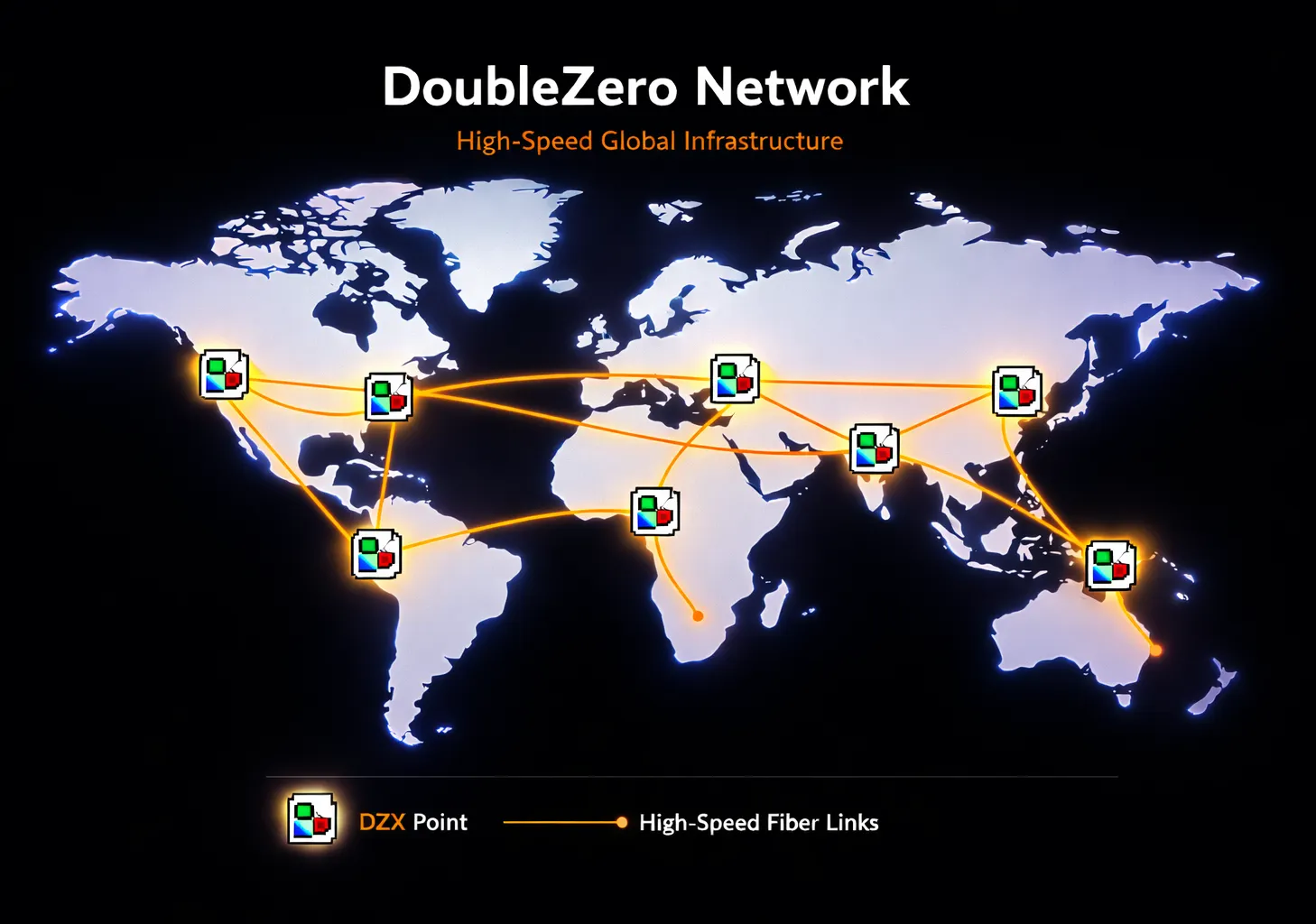
DoubleZero’s “backbone” is made up of 150+ high-performance fiber links across dozens of global locations, contributed by a set of independent infrastructure providers including Jump Crypto, Galaxy, RockawayX, Cumberland & more. These providers often have underutilized capacity on their links that DoubleZero allows them to monetize in a previously inaccessible way.
These links meet at DoubleZero Exchange (DZX) points where traffic is edge filtered & routed efficiently between participants.
Smart-contract-defined networking
DoubleZero describes itself as a smart-contract-defined network: verified information (links, SLAs/availability, routing requests) is stored in on-chain contracts and used to coordinate routing and prioritization.
In practice for Solana, the focus is on accelerating validator-to-validator communications and reducing variance/improving reliability during peak conditions.
Implementation
DoubleZero is designed to be adopted incrementally: validators can opt into using the DoubleZero path while maintaining the ability to fail-over to their existing internet connectivity. This “opt-in with fallback” approach is a core requirement for mainnet safety and operational adoption.
The 2Z token and incentives
DoubleZero’s token known as 2Z, launched alongside mainnet-beta, as an SPL token which powers the network.
What is 2Z for?
- Incentivizes contributors who provide the physical links and bandwidth that enable the network to operate
- Payments for connecting to the network (validators, rpc operators, etc)
- Economic alignment mechanisms, including token burning & staking (still to come)
Who does DoubleZero benefit?
DoubleZero’s value proposition on Solana is not “more TPS” as a headline—it’s more consistent performance by improving validator communication.
Solana ecosystem as a whole
- Higher reliability under load: reduced jitter/latency variance in validator communications can improve the network’s resilience during congestion and stress events.
- Scaling Solana’s geographic footprint by improving inter-region connectivity.
- Edge Filtering out spam and de-duplicating transactions reduces congestion and improves resilience to DDOS attacks
Stakers
- If validator performance improves and skipped slots decrease for participating validators, stakers may see a more stable network and potentially improved staking rewards.
- DoubleZero can improve MEV rewards by allowing searchers/builders to build transaction bundles faster & more efficiently
Solana users
- Fewer “slow” moments: end-users don’t connect to DoubleZero directly, but they experience the downstream effect of improved validator-to-validator shred propagation and more consistent block production.
- Traders on Solana may see tighter spreads & more accurate pricing on assets since market makers are enabled to be more efficient
Validators
This is the group that is most directly benefiting today.
- Deterministic routing over dedicated links can reduce packet loss and improve shred propagation speed.
- Operational upside: for competitive validators, shaving network variance can mean better performance metrics and less sensitivity to less reliable public-internet conditions.
- Validators connected to DoubleZero have seen fewer skipped slots & lower vote latency
RPC operators
- Faster access to the up-to-date state of the blockchain
Current Solana Status
As of writing, DoubleZero operates with:
- Current stake on DoubleZero: ~170M SOL
- Share of Solana mainnet stake on DoubleZero: >40%
- Total Connected Value: >$15B USD
- Validators: ~400
Risks and considerations
DoubleZero is ambitious because it touches a failure-sensitive layer of a high-performance chain: validator networking. Here are the key considerations stakeholders should be aware of:
Physical infrastructure concentration risk
Even with multiple independent contributors, physical networks tend to cluster around the same data centers, connection points, and geographic corridors. If connectivity becomes “the performance moat,” the ecosystem should watch for:
- geographic concentration of DZX points/links
- correlated outages at major facilities/providers
- incentives that unintentionally centralize where “winning” validators can be located
New attack surface + misconfiguration risk
Any additional routing layer introduces:
- new configuration complexity
- new failure modes (bad routes, device issues)
- potential new attack vectors
Looking ahead
As mentioned above, DoubleZero aims to
- Broader services beyond today’s validator comms acceleration, with more programmable routing/service definitions as the network matures.
- More locations + links + operators, expanding the physical footprint and reducing concentration risk while increasing reach.
- Expansion to other high-performance L1/L2 ecosystems, once Solana’s deployment is fully battle-tested.