Solana's Alpenglow upgrade: What it means for stakers and validators
Solana is preparing for the most significant consensus overhaul in its history. Named Alpenglow (SIMD-0326), this upgrade completely re-writes the protocol's legacy architecture to deliver sub-150ms transaction finality. By replacing long-standing core primitives, Alpenglow redefines how consensus is reached & data is propagated through the network, turning Solana into an L1 boasting true, deterministic Web2-speed settlement.
Below is an in-depth breakdown of Alpenglow’s architecture, its timeline, and its economic impacts on validators and stakers.
What is Alpenglow?
Alpenglow is a complete modernization of Solana’s consensus layer. For years, Solana has relied on a combination of Proof of History (PoH) and Tower BFT. While highly performant, Tower BFT requires a multi-step process where votes climb through layers of confirmation, taking nearly 13 seconds to achieve deterministic finality.
Alpenglow throws out this complex, multi-layered architecture. It simplifies the block agreement pipeline down to a fast, direct-voting structure that slashes real finality times by nearly 100x, targeting 100ms to 150ms.
Rollout Timeline
The path to mainnet activation is already underway:
- September 2025: The governance vote for SIMD-0326 passed with overwhelming approval and 52% of total network stake participating.
- May 2026: Core development firm Anza officially activated the Alpenglow consensus upgrade on a live community validator test cluster, validating the "Alpenswitch" transition mechanics.
- Q3/4 2026 (Target): Full mainnet deployment is scheduled to land alongside the release of the Agave 4.1 validator client.
Technical Architecture Changes
Alpenglow achieves its performance boosts by breaking consensus and data routing into two distinct, optimized protocol layers: Votor and Rotor.
1. Votor (Consensus Layer)
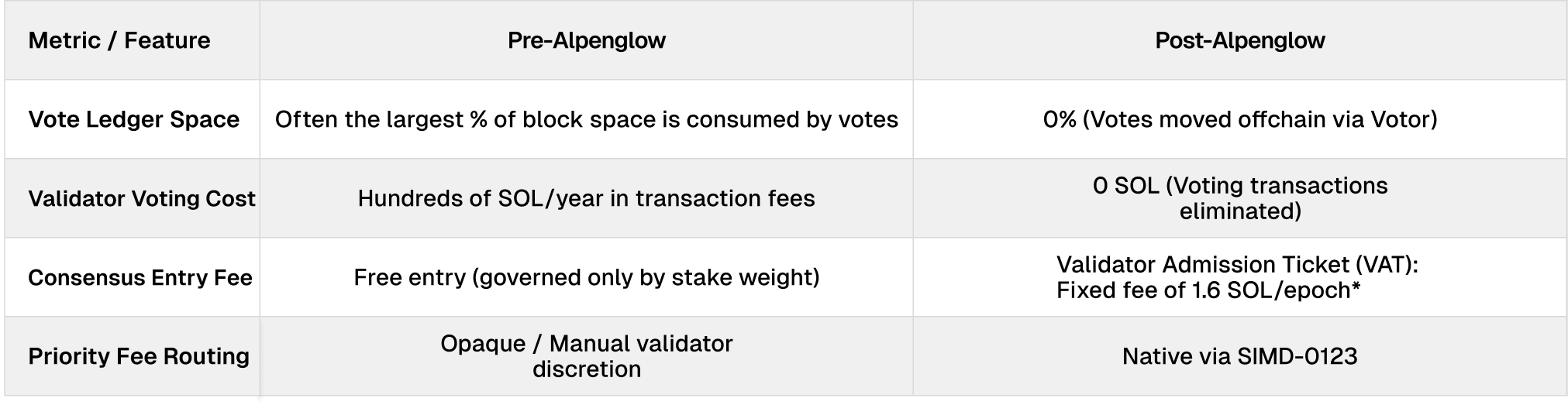
Votor handles the voting mechanism, replacing Tower BFT. Crucially, Votor moves validator votes off-chain. Instead of forcing hundreds of validators to post vote transactions directly into the blocks, validators exchange votes directly. Votor processes consensus dynamically based on active network participation:
- Single-Round Finality: Triggered when >80% of network validators are healthy and actively responding.
- Dual-Round Finality: Triggered if participation drops but stays above a 60% threshold.
2. Rotor (Data Propagation Layer) (to come in a future SIMD)
Rotor will handle the data layer, replacing the legacy Turbine block broadcasting architecture. It utilizes stake-weighted relays paired with aggressive erasure coding to rapidly disseminate block data in a single-hop architecture across the global validator set. By replacing the multi-hop network traditionally used for state alignment, Rotor will greatly reduce bandwidth bottlenecks.
3. The End of Proof of History (PoH)
Proof of History—the cryptographic clock that generated a verifiable sequence of time passing via SHA-256 sequential hashing—has been Solana’s defining signature feature since its whitepaper.
Maintaining a continuous cryptographic clock on-chain introduced severe resource overhead and bandwidth strain under heavy load. Rather than hashing infinitely to prove time, Alpenglow removes PoH and replaces it with locally-measured timeouts anchored by real-time, direct validator communication.
Local Clocks: Ending the "Timing Games"
In the legacy system, Solana validators could economically exploit flaws in the Agave client via "timing games"—deliberately delaying block transmission to earn additional user fees and extract higher MEV values. By removing PoH and utilizing local clocks paired with strict, uniform slots, Alpenglow removes the structural lag incentives that made slot manipulation profitable, stabilizing network-wide block production.
Changes to Staking & Tokenomics
*VAT subject to change
The Value of Freeing Block Space
Moving votes off-chain reclaims a large amount of Solana's existing block space. This capacity expansion means the transaction processing unit (TPU) can dedicate nearly its entire Compute Unit (CU) budget to user-facing DeFi, payments, and smart contract execution, driving structural transaction costs even lower.
Effects on Validators
- Lower Operating Costs: Eliminating onchain voting fees removes some of the fixed capital drag that heavily penalized smaller nodes.
- The VAT Filter: The transition to the fixed Validator Admission Ticket (VAT) replaces voting transaction costs with a flat, predictable baseline operational cost to sit in the active consensus set. These VAT fees will then be burned to help limit inflation.
- Hardware Simplification: Removing Proof of History eliminates the heavy, single-core sequential SHA-256 CPU hashing requirement, shifting the validator hardware bottleneck toward pure network bandwidth and RAM capacity.
Effects on Stakers
- Yield Optimization: With SIMD-0123 landing alongside the upgrade, validators can choose to natively distribute priority fees, directly boosting real staking APY without needing to rely on sometimes opaque off-chain agreements.
- MEV changes: With the introduction of local timeouts, the amount of MEV generated may fluctuate as the ecosystem adjusts to the new paradigm
- No action needs to be taken by Kiln’s stakers & Kiln will handle all necessary technical upgrades for the transition.
Broader Ecosystem Goals
Sub-150ms deterministic finality allows Solana to leapfrog web3 limitations and directly challenge Web2 infrastructure. It unlocks enterprise-grade use cases:
- True High-Frequency Trading (HFT): Central Limit Order Books (CLOBs) can settle near-instantly without fear of block reorganization or optimistic rollback.
- Real-Time Web2-level Interactions: Enhances multiplayer gaming backends, live cross-border remittance streams, and instantaneous global payment settlement on par with Visa.
Agave 4.1 & Protocol Dependencies
The transition to Alpenglow is a phased rollout spread across the Agave 4.x client lifecycle. While Agave 4.0 unlocked prerequisites like Vote Account V4 (separating validator inflation rewards from transaction fee commissions), Agave 4.1 serves as the definitive activation engine for the consensus rewrite.
The Role of SIMD-0123 (Native Block Revenue Sharing)
- What it is: Originally approved by a community vote in March 2025, SIMD-0123 introduces an in-protocol distribution layer for block rewards.
- The Problem: Currently, validators receive 100% of priority fees, but the protocol has no native way to route a portion of these transaction fees back to the delegators whose stake earned the validator those blocks. Stakers must rely on off-chain agreements, trust LST issuers to distribute payouts, or accept manual validator payouts.
- The Alignment: SIMD-0123 is under active development and is expected to ship concurrently with Agave 4.1. It implements on-chain stake reward pools, allowing validators to programmatically share priority fees and MEV revenue directly with their delegators at epoch boundaries. When the Alpenglow architecture evaluates whether a validator meets the financial thresholds to be issued a VAT (below), it must read that specific SIMD-0123 reward pool. It does this to ensure a validator's pending payouts are accurately accounted for before calculating their true, eligible stake weight.
Additional Upgrades expected to ship with Agave 4.1
- SIMD-0286: Increases block capacity limits from 60 million to 100 million Compute Units (CUs) per block.
- SIMD-0387: Enables early BLS public key registration workflows to prepare for Alpenglow's new voting requirements
- SIMD-0296: Larger transaction size enabling more complex operations per transaction
- SIMD-0268: Raises CPI nesting limit from 4 to 8 allowing more complex applications & the ability to call more programs
Technical & Economic Risks
- Reduced Fault Tolerance: To achieve hyper-fast settlement loops, Alpenglow lowers the network's adversarial consensus fault tolerance threshold from the traditional 33% down to 20% as well as an additional 20% for non-malicious drops in stake liveness.
- Centralization Pressures: Compressing the consensus communication loop down to a sub-150ms window means physical geographic proximity matters. Validators located far away from dense data center clusters may face higher block/vote rejection rates, creating an economic incentive for geographic centralization.
- Single-Client Vulnerability: Because these extensive consensus modifications are being deployed directly into the Agave stack, any client-side implementation bug could halt the network. This risk remains acute until independent alternative clients, like Jump Crypto's Firedancer, reach full mainnet production readiness.