The State of Solana: October 2026
.png)
Solana is heading into Q4 2026 at an inflection point. Within the next few weeks, the network is set to activate Alpenglow, the most significant consensus overhaul in its history, while it digests the results of its first binding onchain governance vote and posts record onchain activity.
At the same time, Token2049 week in Singapore brought a wave of institutional announcements, from Samsung bringing USDC on Solana to 82 million Galaxy devices to Securitize launching tokenized U.S. equities.
Below is a breakdown of where Solana stands as of Mid-October, 2026: the Alpenglow rollout, recent governance outcomes, ecosystem announcements, the state of onchain activity, and what it all means for holders and stakers.
Alpenglow: the countdown to mainnet
Alpenglow (SIMD-0326) is now live on Solana's testnet (since September 24) and devnet (since September 25), with mainnet activation expected in the coming weeks. Infrastructure providers are preparing integrators for a mid-October switch.
Jito says it will put all of its BAM block-engine nodes into maintenance mode in the days leading up to activation and will announce timing on its validator Discord. Anza has also been clear that the upgrade will not be rushed: when reports of a September 28 launch circulated, Anza's head of research Roger Wattenhofer answered with "No Alpenrush".
For a full breakdown of the architecture, see our earlier post, Solana's Alpenglow upgrade: What it means for stakers and validators.
Quick recap
- Votor replaces Tower BFT: Validators exchange votes directly and aggregate them into BLS certificates. Thousands of validator votes condense into one small certificate which is checked with a single verification, instead of thousands of separate signatures that have to be sent and checked. This lets Votor build, gossip, and verify finalization certificates in one fast round, which in turn drops finality dramatically. A block finalizes in one round if 80% of stake notarizes it, or in two rounds at 60% thresholds, cutting finality from roughly 12.8 seconds to ~150ms.
- Votes move offchain: In the week to October 6, validator votes made up about 56% of all Solana transactions, roughly 215 million a day against 154–182 million user transactions. Headline TPS will fall sharply at activation. This is an accounting change, not a drop in real activity.
- Proof of History is retired: Tick entries leave the ledger, and are replaced by validator communicated local timeouts.
- Execution is untouched: The SVM, transaction formats, fees and programs stay the same. Rotor, the replacement for Turbine, will follow in a later phase and is not yet scheduled.
Rollout timeline
- July 8, 2026: BLS pubkey management in vote accounts (SIMD-0387) activates on mainnet.
- July 22, 2026: The Validator Admission Ticket (SIMD-0357) activates. Validators without a registered BLS key are removed from the admitted set and stop voting.
- August 2026: A 50,000 SOL bug bounty competition runs, and Agave 4.2 ships with Alpenglow feature-complete.
- September 24–25, 2026: Alpenglow activates on testnet, then devnet.
- October 9, 2026: 200ms slot times go live at epoch 1053, completing SIMD-0525. Blocks now land twice as often as at genesis, and epochs shorten from about two days to roughly one.
- Late-October 2026 (expected): Mainnet activation with Agave 4.3.
Effects on Stakers
- No action needs to be taken by Kiln's stakers: Stake accounts, delegation and reward mechanics carry over, and Kiln will handle all necessary technical upgrades for the transition.
- Faster settlement: Exchanges, bridges and payment flows that wait 12.8 seconds for hard finality will get it in a fraction of a second.
- More block space for users: Removing vote traffic frees capacity for DeFi, payments and application activity, the fee-generating transactions that ultimately support staking yield.
Governance: Solana's first binding vote
In late August, Solana ran its first binding onchain governance ballot, and the result was a split decision: the network ratified a constitution and approved faster disinflation, but rejected a fee-burn redesign. For stakers, the process itself may matter as much as the outcomes, since delegators now have a direct vote.
How Solana Governance Proposals work
The Solana Foundation launched Solana Governance Proposals (SGPs) on July 1, 2026. SGPs are stake-weighted signaling votes that answer "should we do this?", while SIMDs remain the technical specifications that answer "how?".
- Proposal threshold: A validator needs at least 100,000 SOL of active stake to put a proposal onchain.
- Support threshold: A proposal advances to a vote only once endorsements reach 15% of cluster stake.
- Passing: One-third quorum and a two-thirds supermajority.
- Staker sovereignty: Validators vote with all delegated stake by default, but any delegator can override their validator's vote, or vote if the validator abstains.
The August ballot
Voting ran from about August 23 to the end of epoch 1024 on August 28.
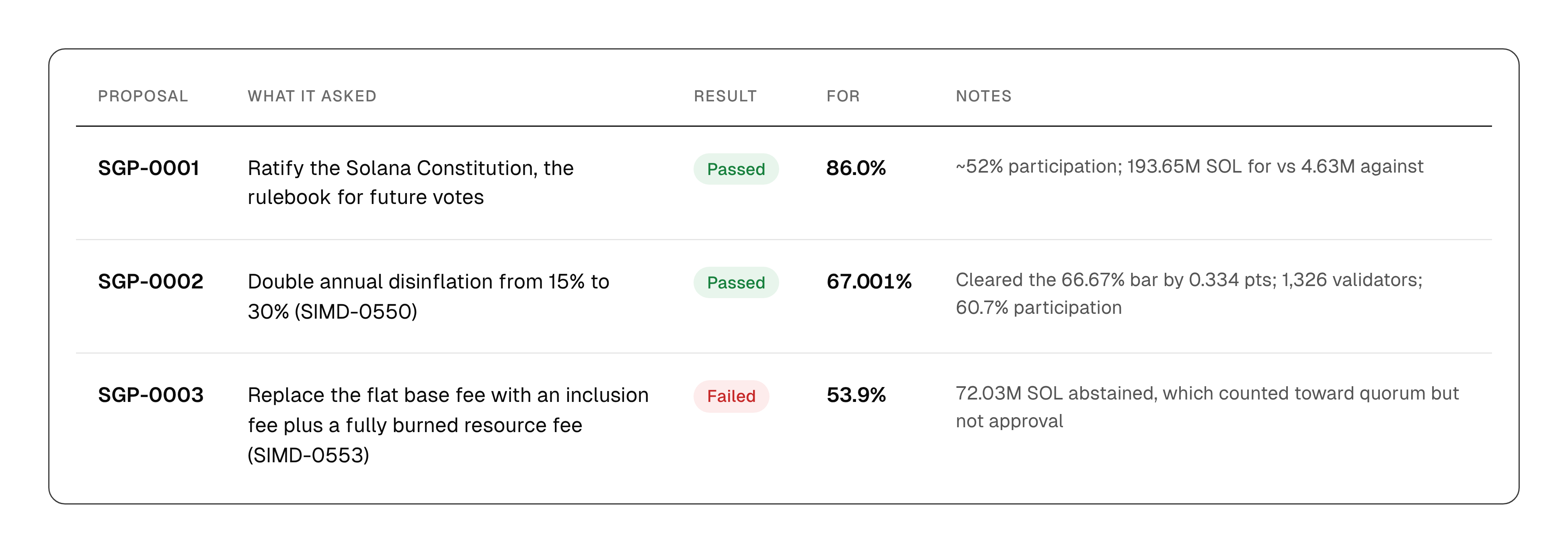
- SGP-0002 came down to the wire: Kraken opposed it through most of the count before switching at the last minute, and Solana Compass credited JitoSOL holders using their override as decisive in the final hours. Once activated, SIMD-0550 brings inflation to its 1.5% terminal floor around 2029 instead of 2032, cutting projected issuance by about 18.9 million SOL over six years.
- SGP-0003 fell short: Opposition came from several applications and staking operators, including Jupiter, Drift and Solana Company (Nasdaq: HSDT), which argued that reopening the network's most stable economic parameters in governance's first cycle could slow institutional adoption. Had it passed, projected daily burns would have risen from about 650 SOL to roughly 7,500–9,000 SOL, still well below the ~60,000 SOL issued daily.
What has and hasn't changed
A passed SGP is a mandate, not a mainnet change. Staking yields today still follow the existing 15% disinflation schedule. The faster curve first needs SIMD-0607 which still has to ship in Agave v4.4 with Firedancer alignment before the feature gate can be scheduled, and no activation date has been published yet. Fees are also unchanged, and Anatoly Yakovenko has suggested splitting the fee proposal into smaller parts rather than abandoning fee reform.
The takeaway for institutional stakers: governance outcomes on Solana can now hinge on how custodians, LST issuers and staking providers cast, or pass through, delegated votes.
SIMDs activated on mainnet since June
Beyond the headline governance votes, most protocol changes ship through the SIMD review process and are switched on by feature gates. Of the SIMD’s activated on mainnet over the past four months, the ones below change network economics or the user experience; the rest are developer-facing or internal hardening. Dates marked "~" are derived from each feature's activation epoch.
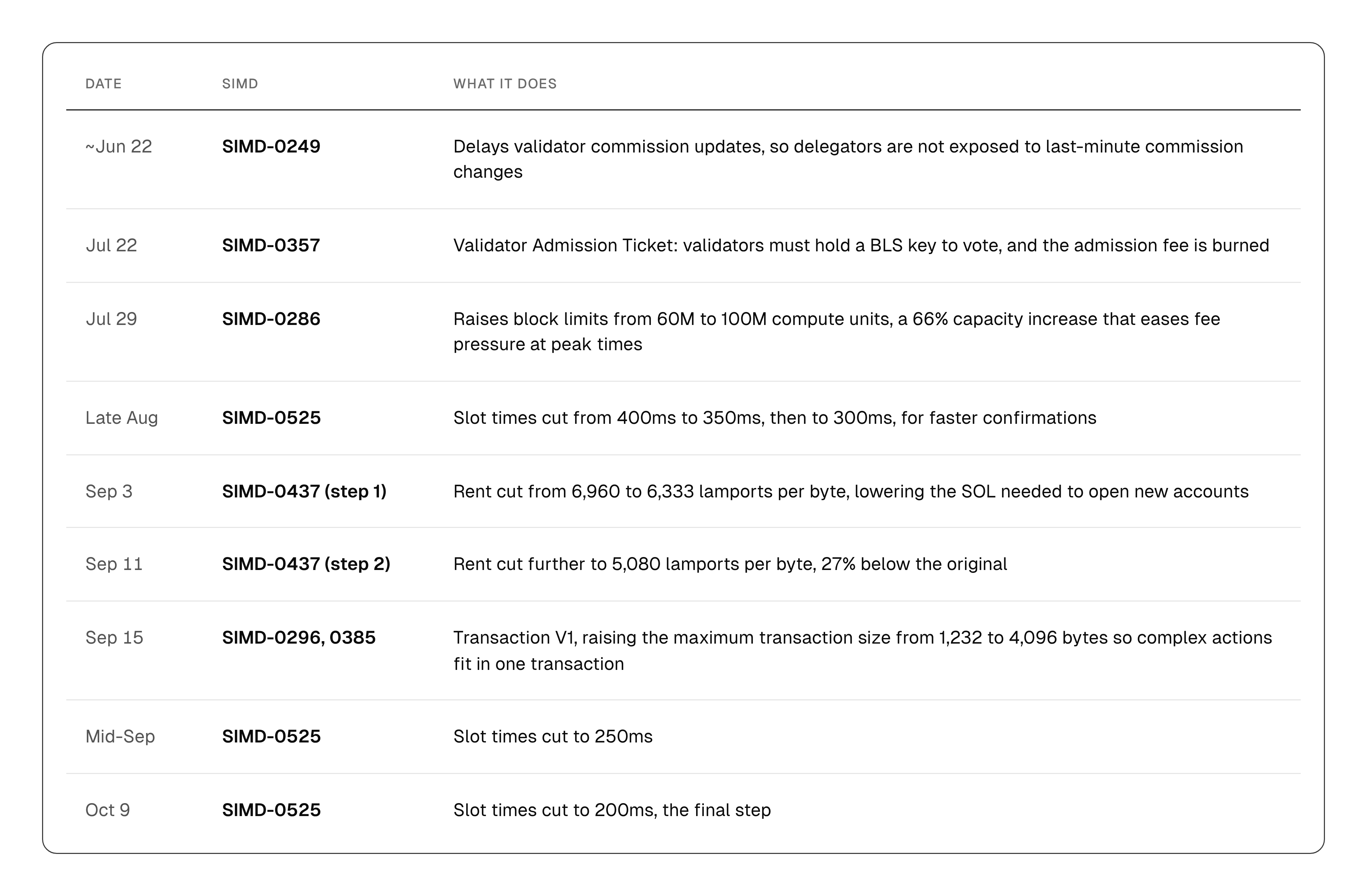
For stakers, the commission changes stand out: validators can no longer change rates at the last minute, and rates can now be priced in basis points. Rent steps 1 and 2 also lower the SOL locked in new stake and token accounts. Rent steps 3–5, which complete the 90% cut, are expected with Agave 4.4 in November, and Alpenglow itself (SIMD-0326) follows with Agave 4.3.
Ecosystem announcements
The past six weeks of Solana announcements cluster around two themes: mainstream payments distribution and regulated tokenized equities. Both came to a head during Token2049 week in Singapore.
Token2049 week (October 5–11)
Token2049 Singapore ran October 7–8 at Marina Bay Sands, drawing 25,000 attendees from 160 countries, with the Solana Foundation among its title sponsors. The Solana Summit Singapore opened the week on October 6, and the Solana Foundation also took part in the debut of TOKEN2049 Institutional, a private gathering of senior finance leaders, on October 8. Key Solana announcements that landed during the week:
- Samsung Wallet (October 7): Samsung Wallet will support USDC cross-border transfers on Solana from the last week of October, reaching 82 million U.S. Galaxy devices, with Bastion and Coinbase to handle custody, and Sui is named as a second network partner. The significance is distribution: Solana-settled stablecoins inside a default wallet, with no seed phrase or separate app.
- Lily Liu on tokenization (October 7): Speaking at Token2049, the Solana Foundation chair framed tokenization as a way to widen global access to U.S. assets rather than compete with retail brokerages, noting that roughly 160 countries account for only about 5% of global stock market value.
- Securitize Stocks (October 8): Securitize launched 12 tokenized U.S. equities on Solana, including Apple, Nvidia, Tesla and Microsoft. Each is backed 1:1 by a share as a UCC Article 8 security entitlement, settles in USDC, and trades with Jump Trading as market maker.
Other key announcements (July–September)
- September 30: Open USD (OUSD) goes live natively on Solana. It is issued by Bridge (Stripe), with fee-free mint and redeem and reserves at BlackRock, Lead Bank and BNY.
- September 17: The SEC issues a five-year Innovation Exemption allowing tokenized NMS stocks to trade on public, permissionless networks.
- September 16: Project Harmonia opens, connecting tokenized funds on Solana to Allfunds' distribution network.
- September 14: Jupiter whitelists Kiln as a partner validator for jupSOL, letting holders direct their delegation to Kiln while keeping their position liquid across Solana DeFi.
- August 28: Bitwise's Solana Staking ETF (BSOL) becomes the first U.S.-listed Solana ETF to pass $1 billion in assets.
- August: Western Union launches Stablecard, a Visa card backed by USDPT, its own stablecoin issued on Solana through Anchorage Digital, live in 37 markets.
- August: MoneyGram Ramps gives Solana apps a single API into MoneyGram's network of nearly 500,000 cash locations in more than 170 countries.
- August: Charles Schwab announces plans to add SOL to Schwab Crypto Direct, reaching a client base of nearly 40 million active accounts.
- August 12: Abra selects Kiln to power Solana staking for its institutional and private clients.
- July 28: Morgan Stanley launches the Morgan Stanley Solana Trust (MSOL) on NYSE Arca. The trust holds SOL and intends to stake a portion of its holdings.
- July 16: E*TRADE from Morgan Stanley opens spot SOL trading to eligible clients.
- July 10: SK Hynix becomes available on Solana as a tokenized stock on the same day as its $26.5 billion Nasdaq debut, the largest U.S. IPO by a foreign company.
Institutional flows
U.S. spot Solana ETFs have taken in about $1.58 billion in cumulative net inflows since launching in October 2025, including $272 million in September alone. Momentum reversed in early October: the funds lost $24.8 million in the week of October 5–9, with outflows in all five sessions, ending a record 14-week inflow streak. It was the largest weekly outflow since launch, led by $20.9 million from Bitwise's BSOL, and total net assets fell to $1.73 billion from $1.90 billion a week earlier.
The outflows coincided with larger withdrawals from bitcoin and ether ETFs, pointing to a broad pullback from crypto risk rather than a Solana-specific issue. Most of these products stake their SOL, making staking yield a core part of the ETF pitch.
A resilience reminder
On August 12, a routing fault at hosting provider Teraswitch knocked 28.83% of staked SOL offline for about 33 minutes, within 4.5 points of the 33.3% threshold at which Solana stops finalizing. A single autonomous system held about 27% of staked SOL, above the Solana Foundation delegation program's 25% cap, and 94% of it went dark at once. The network never halted, but the incident showed that hosting concentration, not just client or validator count, is now one of the network's most visible liveness risks.
What's next
Breakpoint 2026 runs November 15–17 at Olympia London, the conference's first time in the UK, under a "Token Supercycle" theme focused on stablecoins, tokenized assets, payments and AI agents. Samsung's rollout and an expected Alpenglow activation both land in the weeks before it.
Onchain activity: record usage, recovering revenue
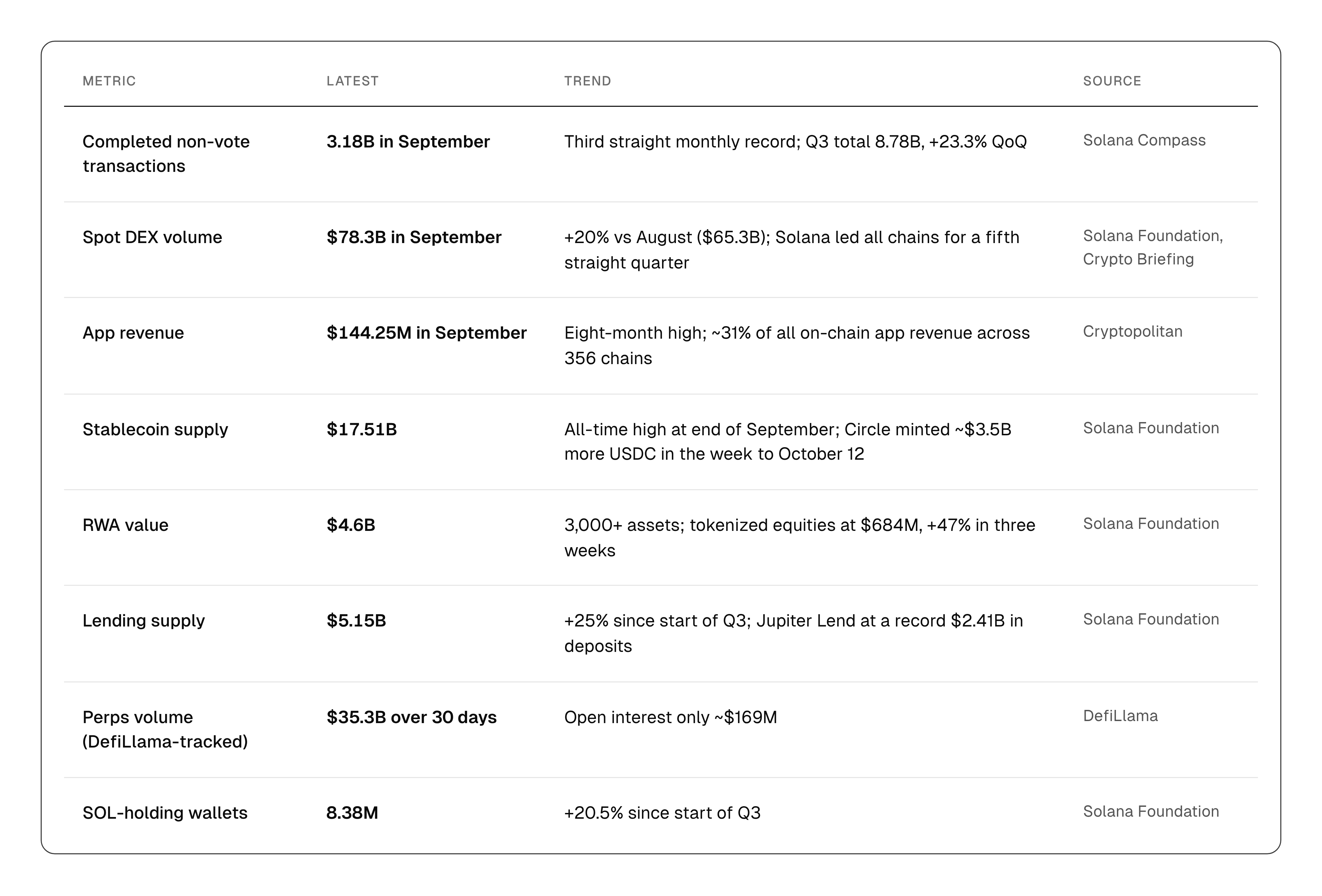
Solana closed Q3 2026 with record user activity and its strongest app revenue since January, while network-level fee revenue is only beginning to recover from a steep H1 decline. Notably, it is stablecoins and real-world assets, not memecoins, that are setting most of the new highs.
By the numbers
Applications and revenue
App revenue has more than recovered from a weak first half. Solana apps earned $143.23M in August and $144.25M in September, up from an average of roughly $85.7M a month in Q2, and set a 2026 single-day record of $7.94M on September 12. Launchpads and trading terminals, led by the Pump ecosystem, Axiom and FOMO, still do most of the earning. The difference from 2025 is breadth: wallets, aggregators, NFT marketplaces and social trading apps now each generate meaningful revenue on their own.
At the network level, the picture is more muted. Real Economic Value (REV), the sum of base and priority fees plus MEV tips, fell to $51.0M in Q2 2026, down 43% from Q1 as memecoin activity unwound. It began turning in July, and by late September weekly REV hit its highest level since January. Priority fees made up about 60% of REV in Q2, which is why in-protocol fee sharing with stakers (SIMD-0123) and the fee debate in governance matter so much to staking yields.
Perps
Solana's perps market has been reshuffled in 2026. Drift, once the largest venue, lost about $285M in an April 1 exploit tied to compromised admin signers and has barely traded since. Volume has moved to newer venues, many of which list equities, FX and commodities alongside crypto.
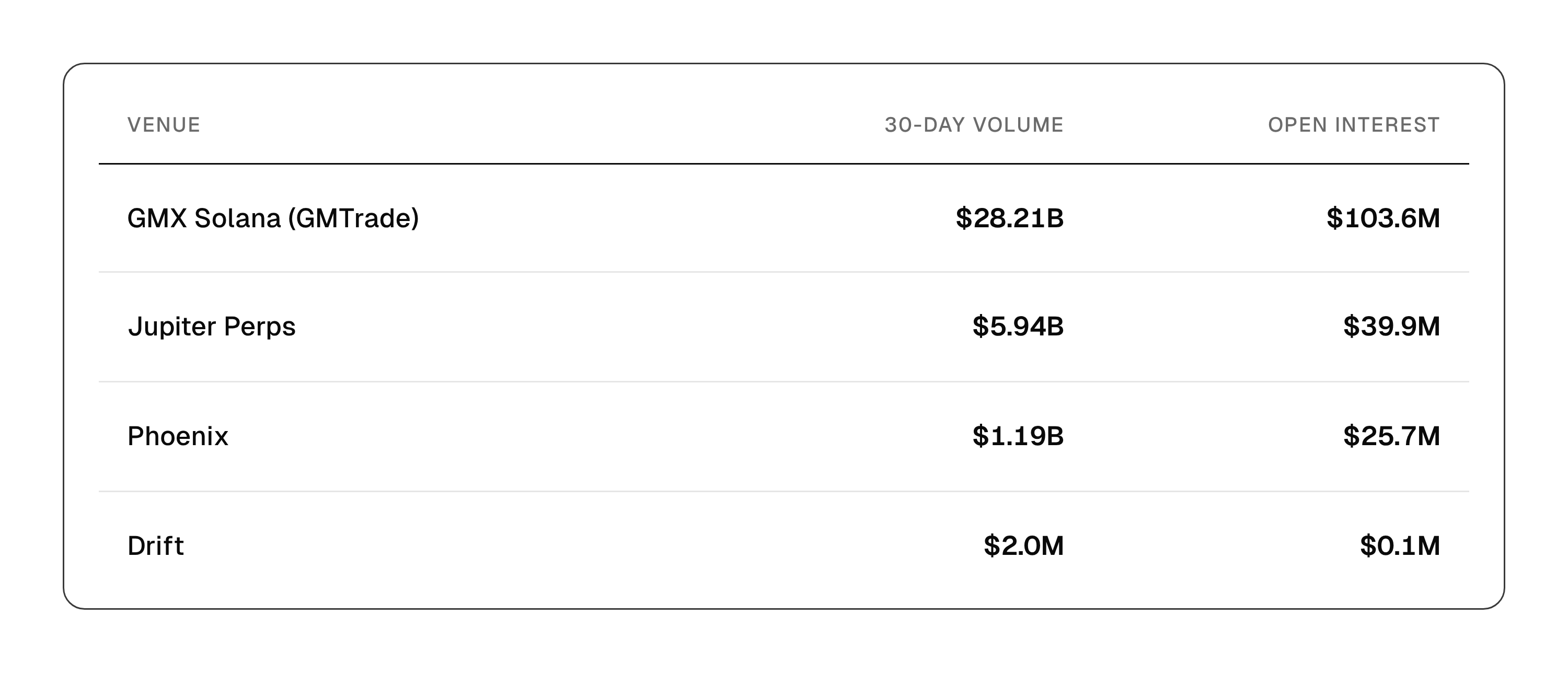
Figures from DefiLlama as of October 9. Volume is high relative to open interest, suggesting short term trading with Solana perps still trailing Hyperliquid by a wide margin.
Jupiter is expanding its perps offering: On September 22, it added six new markets in beta beyond its original BTC, SOL and ETH: HYPE, ZEC, JUP and tokenized SpaceX, SanDisk and SK Hynix, with up to 20x leverage and early access for JUP stakers. The markets run on GUM, a native Solana order book, rather than the JLP pool, which removes the constraint that every market needed deep pooled liquidity behind it. Jupiter's team says more markets are coming.
RWAs and stablecoins
This is where the trend is clearest:
- Stablecoins: Supply hit a record $17.51B, and Solana accounted for 81.7% of cross-chain stablecoin loan volume in September, per Visa on-chain analytics. Issuance has kept accelerating into October: Circle minted about $3.5 billion of USDC on Solana in the seven days to October 12, according to SolanaFloor data.
- Tokenized stocks: Passed 1 million cumulative holder wallets, with roughly $4.4B of September trading volume. Solana has hosted more than half of all tokenized equity volume in 2026.
- Tokenized collateral: Kamino held $20.7M in xStocks collateral in mid-September, and Kraken launched xStocks yield vaults built on it.
With the SEC's September exemption, Securitize's launch and Samsung's rollout all landing within the same six weeks, this segment looks set to keep setting records into Q4.
Price action: a six-month round trip
SOL traded mostly between $80 and $90 through the spring, briefly rallying to about $97 in mid-May, before a sharp sell-off in early June and a strong recovery from mid-August onward. As of October 12, it trades around $108–112, roughly 70% above its early-June low but about 10% below the ~$122 it held as recently as October 4.
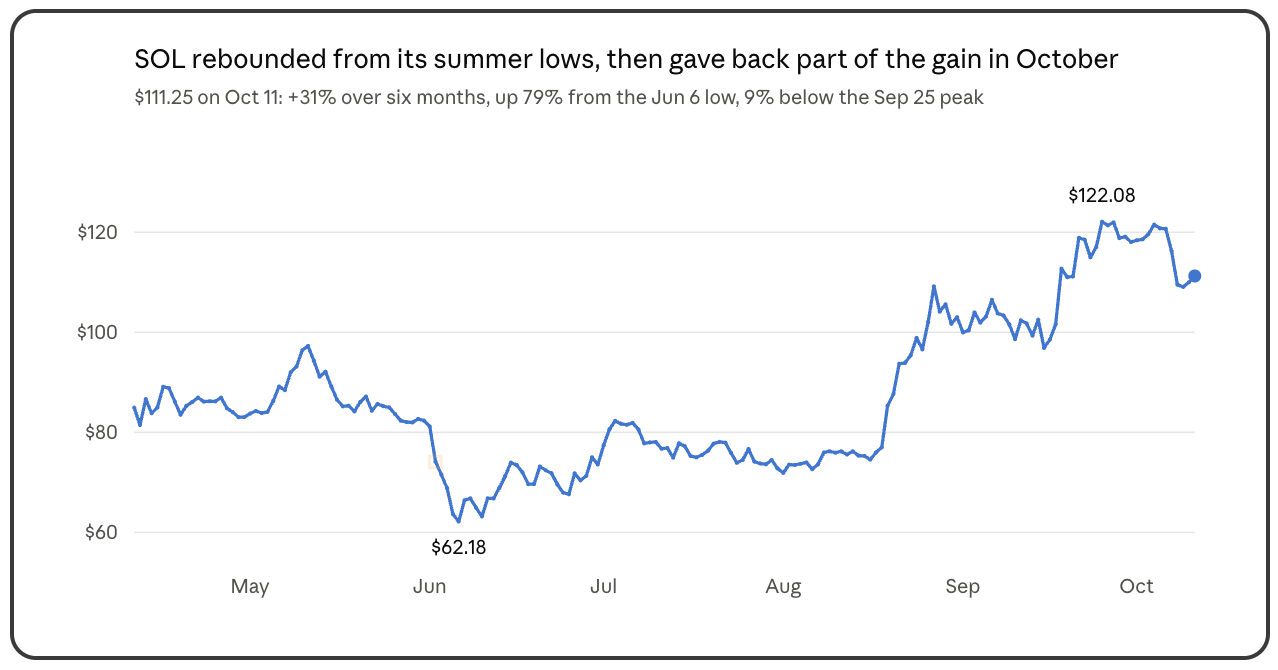
Notably, the October sell-off came in the same week as the Samsung and Securitize announcements, a reminder that SOL's price is still driven more by broad crypto market conditions than by Solana-specific news.
What it means for SOL stakers
The next six months will bring more change to Solana's validator economics and governance than any period in the network's history, yet none of it requires stakers to change how their stake is held. With roughly 70% of SOL supply now staked, these shifts touch most of the network's holders.
Key developments to track:
- Alpenglow activation: No action is needed from Kiln's stakers. More broadly, delegators should confirm their validator or provider has a registered BLS key and is running Agave 4.3
- The disinflation gate: SGP-0002 passed, but yields stay on the current 15% disinflation path until SIMD-0607 and the SIMD-0550 feature gate ship. Once they do, inflation rewards fall faster toward the 1.5% floor around 2029, making fee-based income a larger share of total yield over time.
- Governance participation: SGP-0002 passed by just 0.334 points, and delegator overrides helped decide it. Institutions should know how their provider casts governance votes on their behalf and whether they can override them.
- Infrastructure diversity: The August 12 Teraswitch incident showed that where a validator's stake is physically hosted matters. A provider's data-center and network diversity is now as relevant as its uptime record.
The broader picture is a network whose usage is maturing toward payments, tokenized assets and institutional settlement, just as its consensus is about to get dramatically faster. If that usage keeps growing while issuance falls, a larger share of staking returns will come from real network activity rather than inflation.
Sources
- Kiln: Solana's Alpenglow upgrade, what it means for stakers and validators
- Kiln: Boosted SOL rewards, now live with Jupiter
- Solana Foundation: Alpenglow upgrade page
- Triton One: Alpenglow and your Triton stack
- FinanceFeeds: Alpenglow did not go live on September 28
- Solana Compass: Triton One Alpenglow integrator guide
- Bitfinex: Why Alpenglow is more than speed
- Solana Governance FAQ
- Hubra: Solana's first governance vote
- Decrypt: First binding governance vote closes
- Solana Company: Positions on first SGPs
- Asia Biz Today: TOKEN2049 Singapore 2026 opens
- Solana Foundation: Samsung Wallet partnership
- Kiln: VanEck partners with Kiln for its Solana strategy
- Bloomingbit: Lily Liu on tokenization at Token2049
- Solana Compass: Securitize Stocks launch
- Solana Foundation: Ecosystem Roundup, September 2026
- Decrypt: A routing bug took Solana 86% of the way to losing finality
- 24/7 Wall St.: Solana ETF flows, week ending October 2
- Solana Compass: Breakpoint 2026 in London
- Solana Compass: Record 3.18B transactions in September
- Crypto Briefing: Solana leads spot DEX volume in Q3
- Cryptopolitan: Onchain app revenue, September 2026
- Solana Compass: August app revenue
- Blockworks: Solana Q2 Token Holder Report
- Crypto Briefing: Solana REV hits six-month high
- DefiLlama: Solana perps
- TRM Labs: Drift Protocol exploit
- Solana Compass: Jupiter Perps adds six markets
- Investing.com: Solana historical data
- CoinLore: SOL historical prices
- YCharts: Solana daily price
- FXEmpire: SOL pulls back as DEX volumes decline
- SIMD repository: sync of statuses with mainnet activations (PR #638)
- Anza: Feature Gate Tracker Schedule
- Solana Foundation: Reduced Rent
- Chainstack: Solana rent reduction
- Solana Foundation: Ecosystem Roundup, August 2026
- Solana Foundation: Ecosystem Roundup, July 2026
- Kiln: Abra selects Kiln to power Solana staking
- Solana Compass: Jito details BAM's Alpenglow plan
- BitcoinWorld: Solana activates 200ms slots
- Solana Compass: SIMD-0607 must merge before disinflation can activate
- Solana Compass: Solana ETFs shed about $25M in a week
- Crypto Briefing: Circle mints ~$3.5B USDC on Solana in seven days
- CoinGecko: Solana price history
- CoinCheckup: Solana historical data